Adaptation, Biodiversity, Cities, Water

River Restoration and Urban NbS in Johannesburg, South Africa

In Johannesburg, South Africa, invasive alien species in river systems threaten the city’s water security, increasing flood risk and affecting local biodiversity.

SUNCASA-Johannesburg

Project Details

Johannesburg’s Jukskei River catchment is one of the city’s most degraded urban ecosystems. Invasive alien species, sewage contamination, informal settlements along riverbanks, and aging infrastructure have intensified flooding, water pollution, and urban heat stress—placing vulnerable communities at risk and increasing pressure on municipal systems.

The SUNCASA (Scaling Urban Nature-based Solutions for Climate Adaptation in Sub-Saharan Africa) project is restoring 469 hectares of riparian zones in the Upper Jukskei River catchment and planting 46,000 urban trees. Through gender-responsive nature-based solutions (NbS), including riverbank rehabilitation, invasive species removal, and green space expansion, the project aims to improve water quality, reduce flood damage, manage urban heat, and strengthen climate resilience for approximately 1.045 million residents.

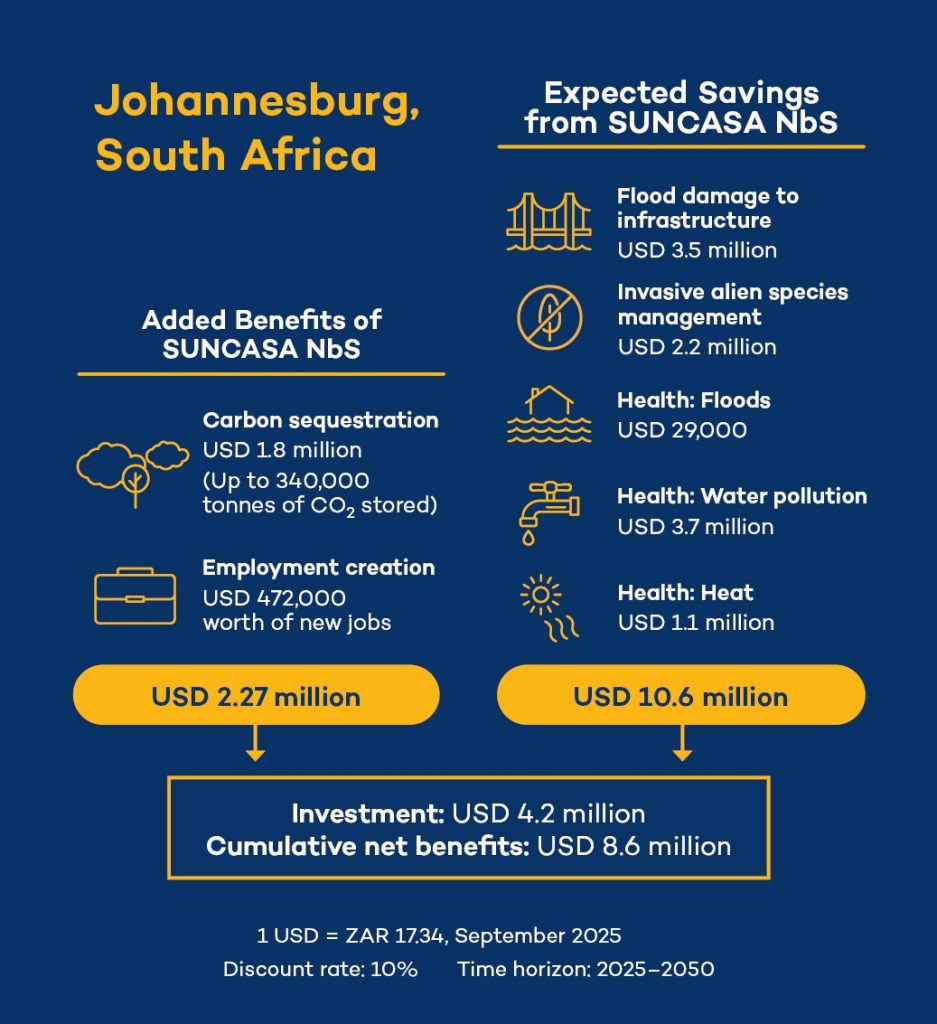
A Sustainable Asset Valuation (SAVi) assessment reveals that these NbS interventions generate substantial long-term economic, social, and environmental returns.

For every USD 1 invested in restoring the Jukskei River, USD 3.06 is returned, with the project paying for itself within seven years.

Improving water quality delivers the largest economic benefit. Avoided health costs linked to water pollution amount to USD 3.7 million over 25 years, underscoring the strong public health dimension of urban river restoration. This is followed by the avoided costs of flood damages to infrastructure which amount to USD 3.5 million over the same time period.

The project also reduces municipal expenditure by lowering invasive alien plant management costs while also decreasing flood damage to infrastructure.

Local partners include Johannesburg City Parks and Zoo, the Johannesburg Inner City Partnership, Zutari, Gender CC, Water for the Future, and the Alexandra Water Warriors.

Photo: Jenna Echakowitz

ABOUT SUNCASA

By 2050, more than 65% of Africa’s 2.5 billion population will live in cities. However, incipient climate governance systems, rapid urbanization, and deforestation have degraded landscapes and ecosystems, affecting urban communities’ capacity to adapt to climate change. The Intergovernmental Panel on Climate Change predicts temperatures in Africa will rise faster than the global land average, and many cities will face water scarcity, droughts, increased urban heat, and greater flood risk from intensifying storm events. As environmental threats multiply, underserved and marginalized communities are likely to experience increasingly adverse impacts.

Jointly managed by the International Institute for Sustainable Development (IISD) and the World Resources Institute (WRI), with USD 22 million in funding from Global Affairs Canada through the Partnering for the Climate Program, SUNCASA will benefit 2.2 million people by increasing their resilience to climate risk, directly train and support over 22,000 individuals involved in implementation, and improve water security for millions more.

The project will work with local partners in Dire Dawa (Ethiopia), Kigali (Rwanda), and Johannesburg (South Africa) to improve vulnerable urban communities’ capacity to adapt to climate change. By adopting and implementing gender-responsive NBS to restore watersheds, riparian corridors, and urban green spaces, the SUNCASA project directly responds to risks like climate change-induced flooding, landslides, extreme heat, and biodiversity loss. SUNCASA also aims to address gender gaps in climate adaptation: at least 50% of the project’s beneficiaries will be women, representing a shift in existing social norms.

Partners